

BRADLEY HOME TEAM
Beaverton Neighborhood Guide
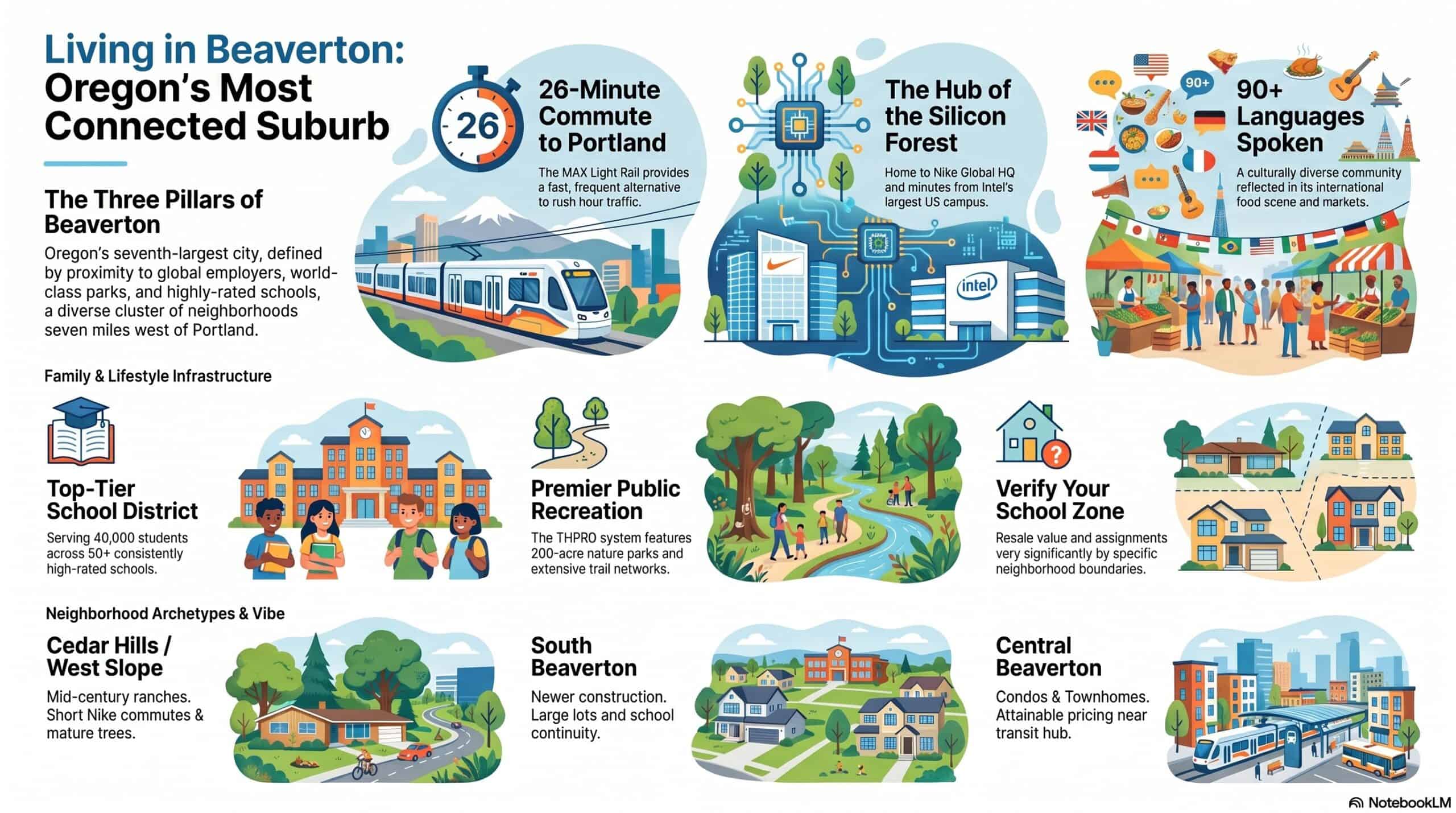
Seven miles west of downtown Portland, tucked into the Tualatin River Valley between the West Hills and the Silicon Forest, Beaverton is one of the metro's most practical and genuinely diverse places to live. It pairs strong schools and real transit access with short commutes to the region's biggest employers — Nike's global headquarters sits inside city limits, and Intel is minutes west in Hillsboro — and it backs all of it with a food and grocery scene that reflects true Pacific Northwest diversity rather than a suburban approximation of it.
Oregon's seventh-largest city, with nearly 98,000 residents, Beaverton is a cluster of distinct neighborhoods rather than a single downtown. The US-26 corridor and the MAX light rail connect it to central Portland in roughly twenty to thirty minutes, and the Beaverton Transit Center is one of the busiest transit hubs in the state.
Homes in Beaverton
Beaverton is best understood as a collection of neighborhoods, each with its own era, price point, and feel. Established areas like Cedar Hills and West Slope offer mid-century ranches on sidewalk-lined streets with mature Douglas fir, prized for their short Nike commutes and MAX access. Family-favorite South Beaverton neighborhoods — Murrayhill, Sexton Mountain, and the Progress Ridge area — lean toward newer construction on larger lots with strong school continuity. Central Beaverton, near the transit center, offers the city's most attainable entry point with condos, townhomes, and older single-family homes.
That range is Beaverton's strength: you can find a walkable condo near MAX, a mid-century ranch under the firs, or a newer family home against Cooper Mountain, often within the same city and school district. Newer buildouts on the southern and western edges continue to add turn-key options for buyers coming from Portland who want more house without a long commute.
A buyer's note: Beaverton spans a wide range of eras, price points, and school attendance zones. Because value here tracks closely with the specific neighborhood and school assignment, confirm both for any address before you commit.
What Makes Beaverton Different: Transit, Jobs, and Diversity
Three things set Beaverton apart from its westside neighbors, and together they define daily life here.
Real Transit Access
Beaverton is one of the most transit-connected suburbs in Oregon. The MAX Blue and Red Lines run from the Beaverton Transit Center to downtown Portland in roughly twenty-six minutes without touching I-405 — a genuinely fast, frequent option that removes the US-26 rush hour from the morning entirely, and a feature buyers here value more than almost anything inside the house.
The Silicon Forest Job Market
Nike's global headquarters sits on a large campus inside Beaverton, and Intel's largest US campus is minutes west in Hillsboro, with Tektronix and dozens of other tech and manufacturing employers along the corridor. For many residents, that means a commute measured in single-digit minutes rather than the forty-plus it would take from Portland's east side.
Genuine Diversity
Beaverton is one of Oregon's most linguistically and culturally diverse cities — more than ninety languages are spoken in Beaverton School District homes. That diversity shows up richly in daily life: a Korean business district along Canyon Road, standout Vietnamese, Chinese, and Indian food, and one of Oregon's largest farmers markets.
Schools
Beaverton is served by the Beaverton School District, one of Oregon's largest — roughly 40,000 students across more than 50 schools — and consistently rated among the strongest in the state. For many families relocating here, the district is a bigger draw than any single neighborhood.
Elementary and Middle
The district's schools serve distinct neighborhood footprints, with family-favorite feeder patterns in areas like Murrayhill (Nancy Ryles Elementary, Conestoga Middle) offering elementary-through-high-school continuity. Because assignments vary by neighborhood, verify the feeder pattern for any home.
High School
Well-regarded high schools including Sunset, Southridge, Mountainside, and Westview serve different parts of the city and its surroundings, each anchoring its own set of neighborhoods.
A buyer's note: Beaverton School District boundaries determine which schools an address feeds into, and buyers near the edge of an attendance zone sometimes find resale value doesn't track the way they expected. Verify the specific assignment before making an offer.
Lifestyle
Beaverton is built around proximity, and it shows in how people live day to day. The city has quietly assembled real amenities — a performing arts center, the beloved Beaverton Farmers Market (one of Oregon's largest), Cedar Hills Crossing and the Streets of Tanasbourne for shopping, and a world-class international food scene — alongside neighborhoods that range from affordable condos near the transit center to half-million-dollar homes against Cooper Mountain.
The overall feel is a functional, family-oriented city that prizes daily logistics: strong schools, real transit, short commutes, and abundant parks. It's less about postcard scenery than about a life that simply works, with Portland's culture a quick MAX ride away and wine country, the coast, and Mount Hood all within reach for weekends.
Getting Around
Beaverton is one of the metro's most connected suburbs. US-26 and Highway 217 carry drivers to Portland, Hillsboro, and the wider region, and the MAX Blue and Red Lines offer a fast, frequent rail option into the city and out toward Hillsboro. Within town, the extensive Tualatin Hills Park & Recreation District trail network makes walking and cycling practical. Be aware that surface arterials like Canyon Road and TV Highway (Route 8) run heavy at rush hour — many residents lean on MAX and back routes to avoid them.
Parks and Recreation
Beaverton's parks system, run largely by the Tualatin Hills Park & Recreation District, is one of the best in the metro and a genuine reason to live here.
Tualatin Hills Nature Park
A large forested nature park with miles of trails and a nature center — a wild, close-in escape run by THPRD.
Cooper Mountain Nature Park
Roughly 200 acres of oak woodland, prairie, and spring wildflower meadows on the city's southwest edge, with sweeping Tualatin Valley views.
Fanno Creek Trail and Commonwealth Lake
A popular multi-use greenway plus a beloved neighborhood lake park — everyday recreation woven through the city.
THPRD Facilities
An extensive network of recreation centers, pools, sports fields, and trails across the district — an unusually deep bench of public recreation for a suburb.
People Also Ask
How is the commute from Beaverton to Portland?
Quick by metro standards. The MAX Blue Line reaches downtown Portland from the Beaverton Transit Center in about twenty-six minutes, and driving via US-26 runs roughly twenty minutes off-peak (longer at rush hour). That transit access is one of the main reasons buyers choose Beaverton.
Is Beaverton a good place for families?
Yes — it's one of the most popular suburbs for Portland-area families, thanks to the highly regarded Beaverton School District, an extensive parks and recreation system, and strong family infrastructure. School assignment varies by neighborhood, so verify the feeder pattern for a specific home.
What is Beaverton known for?
It's best known as the home of Nike's world headquarters and a hub of Oregon's Silicon Forest tech corridor, for its MAX light rail access to Portland, its top-rated schools, and one of the most genuinely diverse food and grocery scenes in the state.
Ready to explore Beaverton?
With strong schools, real transit, and short commutes to the westside job market, Beaverton draws steady, well-informed demand across a wide range of budgets — and knowing the neighborhoods and school zones makes all the difference. That's where we come in.