

BRADLEY HOME TEAM
Vancouver Neighborhood Guide
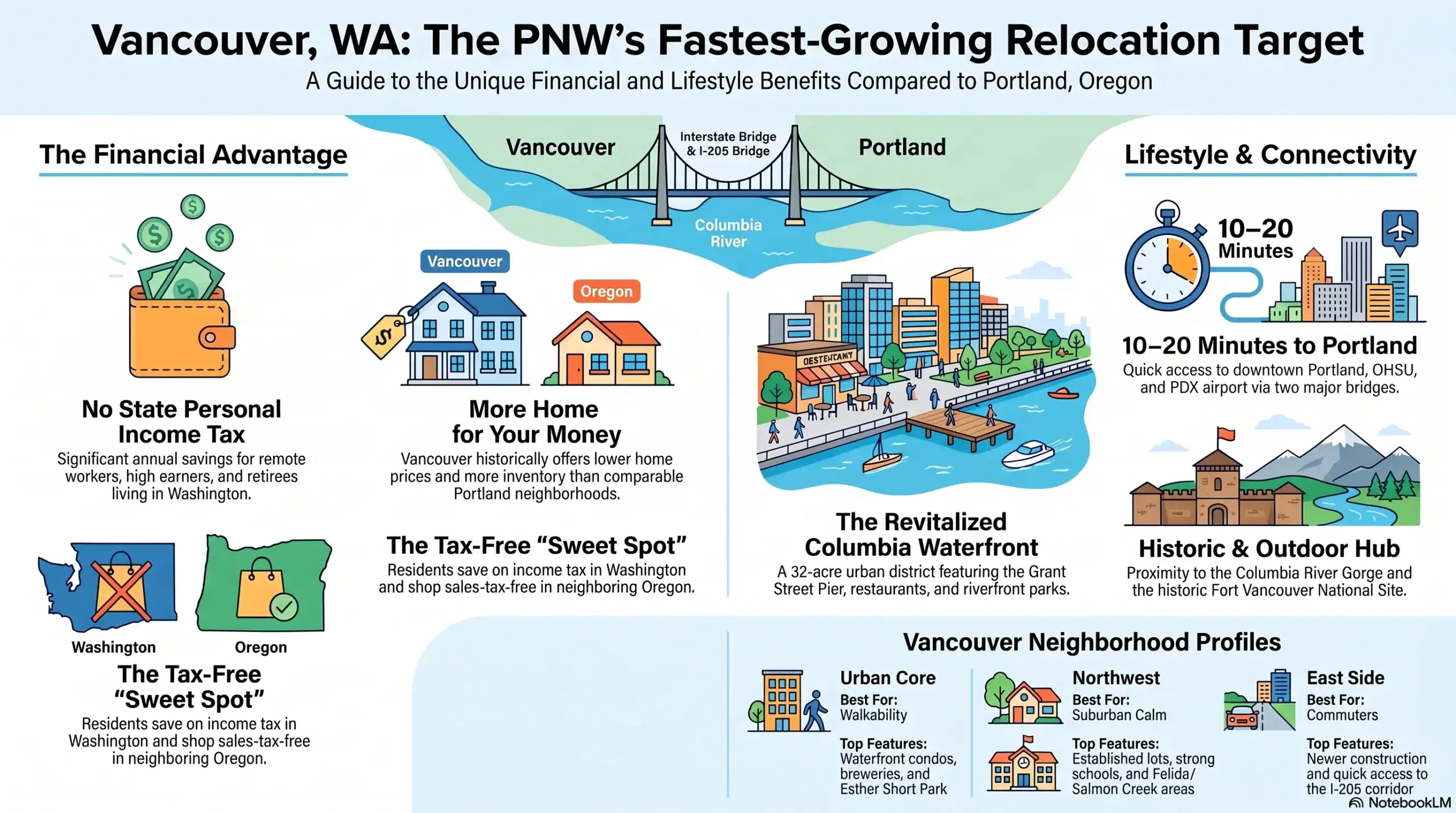
Across the Columbia River from Portland, on the Washington side, Vancouver offers the Pacific Northwest lifestyle of its larger neighbor — the restaurants, the culture, the access to the Gorge and the mountains — with a distinct financial twist: no Washington state income tax. That single fact, paired with a revitalized riverfront, historic charm, strong schools, and home prices that generally run below comparable Portland neighborhoods, has made Vancouver one of the fastest-growing and most talked-about relocation targets in the metro.
The largest city in Southwest Washington, Vancouver sits in Clark County directly across the Columbia from Portland, connected by the I-5 and I-205 bridges. Home to more than 200,000 residents, it combines a genuinely happening downtown and waterfront with established residential neighborhoods, Fort Vancouver's history, and quick access to Portland's job market just ten to twenty minutes south.
Homes in Vancouver
Vancouver's housing spans a wide range, and the neighborhood you choose shapes both lifestyle and price. Downtown and the revitalized Columbia Waterfront offer walkable, urban-style living — condos and townhomes steps from restaurants, breweries, and riverfront trails. Established areas like Felida and Salmon Creek to the northwest offer larger lots, suburban calm, and strong schools, while Fisher's Landing East on the east side draws commuters with newer construction and quick I-205 access. More affordable options cluster along the central Mill Plain corridor and in east Vancouver.
New construction — detached homes, townhomes, and condos — is a regular feature of the market, and inventory has generally been more plentiful than in Portland proper. Across the range, Vancouver has historically offered more home for the money than comparable Portland neighborhoods, though the gap has narrowed as demand has grown.
A buyer's note: school ratings and attendance boundaries in Vancouver can shift block by block, and the city spans several districts. Research the specific attendance area — not just the neighborhood name — and, on older homes, budget for systems like roof, HVAC, and plumbing.
What Makes Vancouver Different: The Tax Advantage and the Waterfront
Two things define Vancouver's appeal and set it apart from the Oregon side of the metro.
No State Income Tax
Washington levies no state personal income tax, which can mean meaningful annual savings — especially for remote workers, high earners, and retirees whose income isn't earned in Oregon. The trade-off is Washington's sales tax (Oregon has none), so many residents make big purchases across the river. The math doesn't favor everyone equally — wages earned in Oregon remain subject to Oregon income tax — so it's worth running your own numbers, but for many households the savings are real and substantial.
The Columbia Waterfront
Vancouver's waterfront has been transformed from industrial land into one of the region's most compelling urban districts — roughly 32 acres and 21 new city blocks with a seven-acre park, the landmark Grant Street Pier, restaurants, and residences along the Columbia. Paired with historic Esther Short Park, Uptown Village, and downtown, it gives Vancouver a genuinely walkable, amenity-rich urban core.
Portland Access Without Portland's Costs
Downtown Portland, OHSU, and Portland International Airport are all roughly ten to twenty minutes away, so residents keep full access to the larger metro's jobs, culture, and dining while living on the Washington side. Bridge traffic at peak hours is the real trade-off to weigh.
Schools
Vancouver is served by multiple school districts — primarily Vancouver Public Schools and Evergreen Public Schools, with parts of the area reaching into Ridgefield and other districts. All have strong reputations, but because the district and specific schools change by address, confirming the boundary is essential.
Elementary and Middle
Which schools serve a home depends on the district and neighborhood — GreatSchools ratings can vary noticeably even between nearby schools. Verify the district and feeder pattern for any specific address.
High School
High school assignment likewise depends on the district and neighborhood across Vancouver Public Schools, Evergreen, and adjacent districts.
A buyer's note: Vancouver spans several districts, and ratings can differ block to block. Confirm which district and which schools serve a specific home before making an offer — don't assume from the city or neighborhood name.
Lifestyle
Vancouver blends small-town friendliness with big-city access. Its rapidly expanding downtown and waterfront offer public art, breweries, diverse restaurants, farmers markets, and riverfront events, anchored by Esther Short Park's bell tower and the historic Kiggins Theatre. Fort Vancouver National Historic Site and Officers Row add genuine history, and the outdoors is everywhere — the Columbia River Gorge is about twenty minutes east, Mount Hood and the coast within easy reach.
The city draws a mix of Portland commuters, remote professionals, families, and retirees, many drawn by the tax advantage and the value proposition. It's a community that has invested heavily in revitalizing its neighborhoods and gathering spaces, giving it real momentum and an increasingly urban, amenity-rich feel.
Getting Around
Vancouver connects to the wider metro via Interstates 5 and 205, which cross the Columbia into Portland, and State Route 14 running east toward Camas and the Gorge. The local C-TRAN transit system serves the city and offers express and park-and-ride connections into Portland, including links to MAX light rail. Downtown and the waterfront are walkable, but most of Vancouver is car-oriented. Bridge congestion on I-5 near the Interstate Bridge is the metro's notable bottleneck — worth factoring into any Portland commute.
Parks and Recreation
Vancouver pairs its urban core with the Columbia River and abundant nearby nature.
Columbia Waterfront and Renaissance Trail
A revitalized riverfront with a seven-acre park, the Grant Street Pier, dining, and a paved trail along the Columbia — the city's signature outdoor gathering place.
Esther Short Park
A historic five-acre downtown park with a bell tower, splash pad, farmers market, and year-round events — the heart of downtown Vancouver.
Fort Vancouver and Officers Row
A National Historic Site with reconstructed fort, gardens, and the stately homes of Officers Row — history and green space woven into the city.
The Columbia River Gorge
World-class hiking, waterfalls, and windsurfing about twenty minutes east, with Mount Hood and the Pacific coast within a comfortable drive.
People Also Ask
Does living in Vancouver, WA really save on taxes?
It can. Washington has no state personal income tax, which can mean significant annual savings — especially for remote workers, high earners, and retirees. The offset is Washington's sales tax (Oregon has none), and wages earned in Oregon are still subject to Oregon income tax. The math varies by household, so it's worth confirming with a tax professional.
How far is Vancouver from Portland?
Just across the Columbia River — downtown Portland, OHSU, and Portland International Airport are all roughly ten to twenty minutes away via the I-5 or I-205 bridges. Bridge traffic at peak hours is the main variable.
What is the Vancouver Waterfront?
It's a revitalized riverfront district built on former industrial land — roughly 32 acres and 21 city blocks with a seven-acre park, the landmark Grant Street Pier, restaurants, and residences along the Columbia, now one of the region's most popular gathering spots.
Ready to explore Vancouver?
Between its tax advantage, revitalized waterfront, and value relative to Portland, Vancouver draws steady, well-informed demand — and knowing the neighborhoods, districts, and tax math makes all the difference. That's where we come in.